
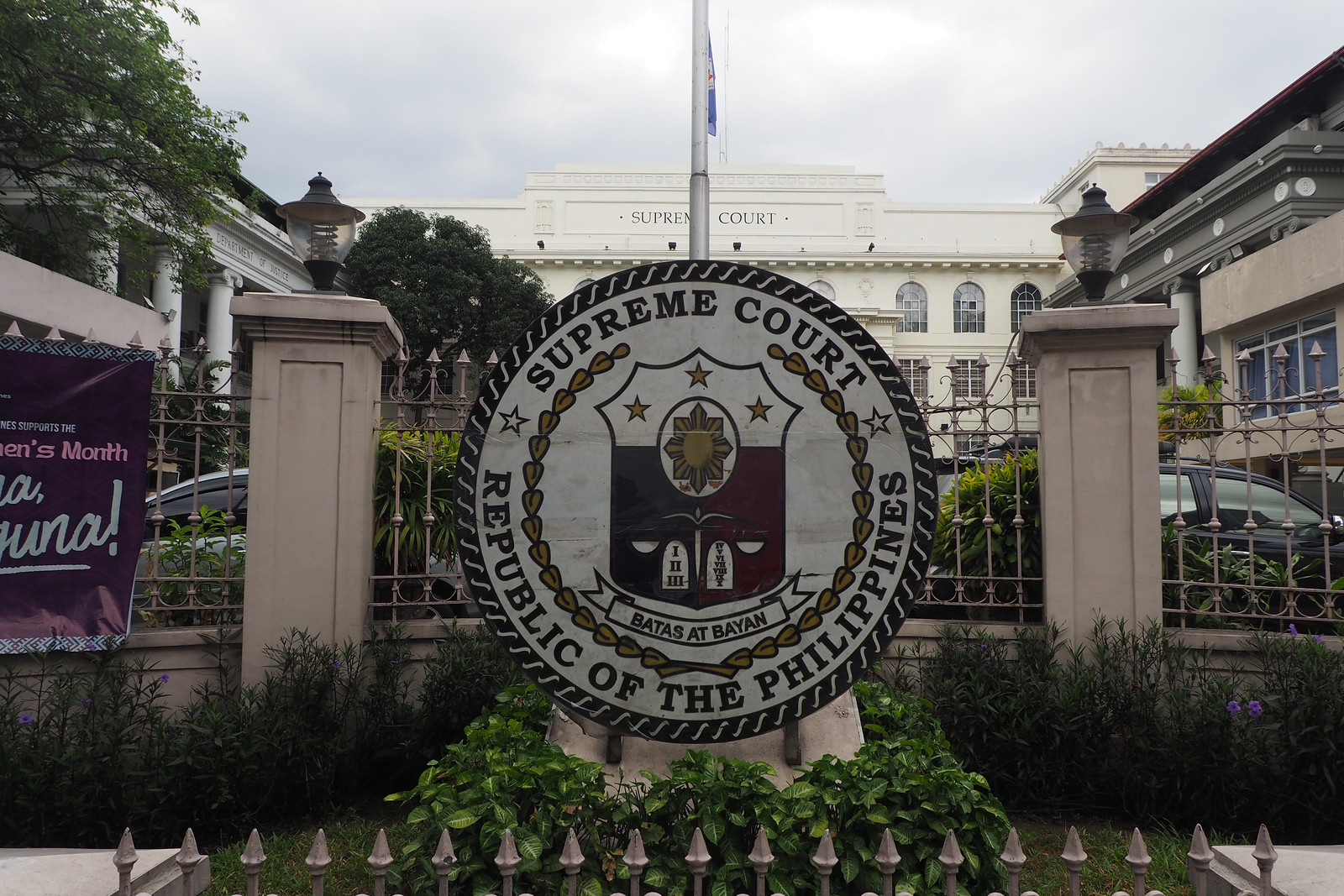
This year marks the 125th anniversary of the Supreme Court of the Philippines. To mark the occasion, the Supreme Court organized a series of free tours, one of which the Urban Roamer was fortunate to join.

The tour was a rare opportunity (for this roamer at least) to visit the high court’s hallowed halls in Ermita. But moreso, it was a great opportunity to learn more about the history of the Supreme Court through the places it has occupied throughout history.
And for that, this story begins in Intramuros
The High Court in the Walled City
When the American colonial government established the Supreme Court of the Philippines on June 11, 1901, it was decided that this newly-established high court would hold office in one of the most historically-significant structures in Intramuros, the center of government of the Spanish colonial period. In particular, the building chosen was the building once occupied by the Real Audiencia de Manila, located right beside the old Palacio de Governador (the old office of the Spanish Governor General of the Philippines) and across the Manila Cathedral.

The Real Audiencia was considered the high court of the Spanish colonial period. While it was not the independent judicial branch that we are familiar with in modern democratic countries (as the “chief justice” of the Real Audiencia is the governor general himself), the Real Audiencia was the body that established the judicial system in the Philippines. So as a symbolic way to establish the continuity of the judicial system in the Philippines (albeit doing away with the Spanish legal system of the old), as well as to honor the Real Audiencia’s place in Philippine history, the Supreme Court, beginning with the tenure of its first Chief Justice Cayetano Arellano, would hold office there until 1938 and the building itself would be named Arellano Building in his honor.

By 1938, the Supreme Court found itself needing a somewhat larger space. The Chief Justice during that period, Ramon Avanceña made the call for the court to move to a larger space not far away from the Arellano Building. That new space was the Ayuntamiento de Manila, which previously housed the office of the Spanish Governor General and the Philippine Assembly.
However, World War II and the Battle of Manila in 1945 would lay both the Arellano and Ayuntamiento buildings to ruin. It would take more than 50 years for the Ayuntamiento to be rebuilt while the Arellano Building was never rebuilt, and remains an empty space used as a parking lot these days. Such a shame that the old Real Audiencia could not be rebuilt in honor of the rich history that place holds in our history.

If there is any consolation, a couple of judiciary-related landmarks have managed to survive in modern Intramuros. One is the Araullo Building, named after Manuel Araullo, the third Chief Justice of the Supreme Court. It was built around the 19th century as a one-storey Spanish military garrison but when the Americans came, it was expanded with the addition of another floor to house the Court of First Instance of Manila. Having survived the war, the building would become the first headquarters of the Bureau of Immigration then occupied by the Commission on Elections (COMELEC) which still uses the building in some capacity.

Across the Araullo Building is an open space named Plaza Willard. Named after Charles Andrew Willard, an Associate Justice of the Supreme Court (1901-1909), it was laid out in 1925, occupying the former site of the Seminario Conciliar de San Clemente (1705–1708), the first seminary in the Philippines for the native clergy.

The move to Ermita
With its homes destroyed by war, the Supreme Court had to find a new home. Looking beyond the mostly-leveled Intramuros, the court set its sights on Ermita, particularly the campus of the University of the Philippines (UP) which at least had some of its buildings standing, albeit damaged by the war.
At that time, UP was already in the middle of a move to a larger space in Diliman, right near the planned National Capitol. The plans were made as early as 1939; if anything, the war and the Battle of Manila further necessitated the move which was envisioned to be completed by 1949. Some of UP’s colleges, like the College of Medicine, would remain in the Ermita campus. But the buildings that would be left behind by other colleges were seen as valuable, especially for the many government offices that lost their buildings during the war.

By the time UP completed its move in 1949, some key buildings and sites of the UP Manila campus were acquired by different agencies. For instance, the old College of Engineering building became the home of the Court of Appeals, as well as the two statues that belong to the La Madre Filipina that used to stand in Jones Bridge (the ones in the present Jones Bridge are replicas, save for one). The original Palma Hall (named after UP President Rafael Palma) became the home of the Department of Justice. The former University Library became the home of the Department of Foreign Affairs. And the old Villamor Hall (named after UP’s first Filipino President Ignacio Villamor), which housed the old UP Conservatory of Music and School of Fine Arts would be transformed to be the home of the Supreme Court for the next 42 years.

The Old Supreme Court Building
The former UP Conservatory of Music and School Fine Arts was originally built in 1933, designed by the notable architect Juan Arellano who also designed the Metropolitan Theater and the Post Office Building, among many others. It featured sculptures done by Guillermo Tolentino, particularly the figures representing Moses and Lady Justice, as well as busts of those who served in the high court over the years (at least the 1950s) that adorn the building’s upper portion.

Perhaps the most notable area of the building was the old concert hall used by the conservatory students. And when the Supreme Court moved in, it was decided that this area would be their session hall. One can imagine the good acoustics of the hall during hearings and oral arguments being held there.

The building itself is not as large, but it served the needs of the court during the country’s most formative years. But as the Supreme Court grew and the judicial system evolved, the building was found to be somewhat lacking in addressing the court’s evolving needs. However, it still played an important role in the court’s affairs. So when the time came for the move, the building, now called the Old Supreme Court Building, was repurposed to be the office of the Court Administrator of the Philippines, whose role is to oversee the operations of lower courts under the Supreme Court. Meanwhile, the old session hall was converted in the museum dedicated to the history of the court.

The New Supreme Court Building
When the time came for the Supreme Court to move, it did not have to look far. In fact, it only had to move a few meters ahead when in 1991, the Department of Foreign Affairs would move to its new office in Pasay, leaving their old home which was the former UP Library behind. Eventually, the Supreme Court secured their moved most of its offices into what is now called the New Supreme Court Building.

Originally built between 1928-1930, the building was designed by Antonio Toledo, the same architect behind the National Museum of Natural History building and the Manila City Hall. Now repurposed as the home of the high court, the entrance is flanked by two figures, representing the first Chief Justice Cayetano Arellano and Chief Justice Jose Abad Santos, the chief justice who valiantly resisted Japanese rule and paid his life for it.


Most of the areas in the Supreme Court serve as offices of the justices, as well as other staff members. But there are three areas that would be of interest to the public. The first is the Dignitaries Lounge located at the left of the main entrance where the Chief Justice would usually receive important guests, as well as a venue for civil weddings. (yes, a Supreme Court justice can officiate a civil wedding)

The second is the Division Hearing room right across the Dignitaries Lounge. If a case to be reviewed does not require the decision of all 15 members of the high court, then this room is where a division of the Supreme Court (usually three) would hold their sessions. Otherwise, this is where press conferences are held.

Finally, there is the session hall itself located at the second floor, an area that exudes the importance and the power of the Supreme Court. Here, all 15 justices of the high court would meet in an en banc session to decide on important cases and provide interpretation on provisions in the constitution or the laws. The chief justice would be seated at the center of the semi-circular desk, with the rest of the justices seated according to seniority or their length of tenure within the high court.

A future move?
Despite the Supreme Court seemingly at home at Ermita, there have been some discussions about a potential move. Primarily because the University of the Philippines still owns that property and the high court is keen on getting a place that they can truly call their own.

Back in 2015-2018, the Supreme Court bore plans for what was to be its new home in Taguig, right at McKinley Hill. In fact, there was already a rendering of the proposed building by Mañosa Architects, which was chosen from the entries submitted in a prior competition. Furthermore, the groundbreaking for what would have been the new home of the Supreme Court happened in 2015.
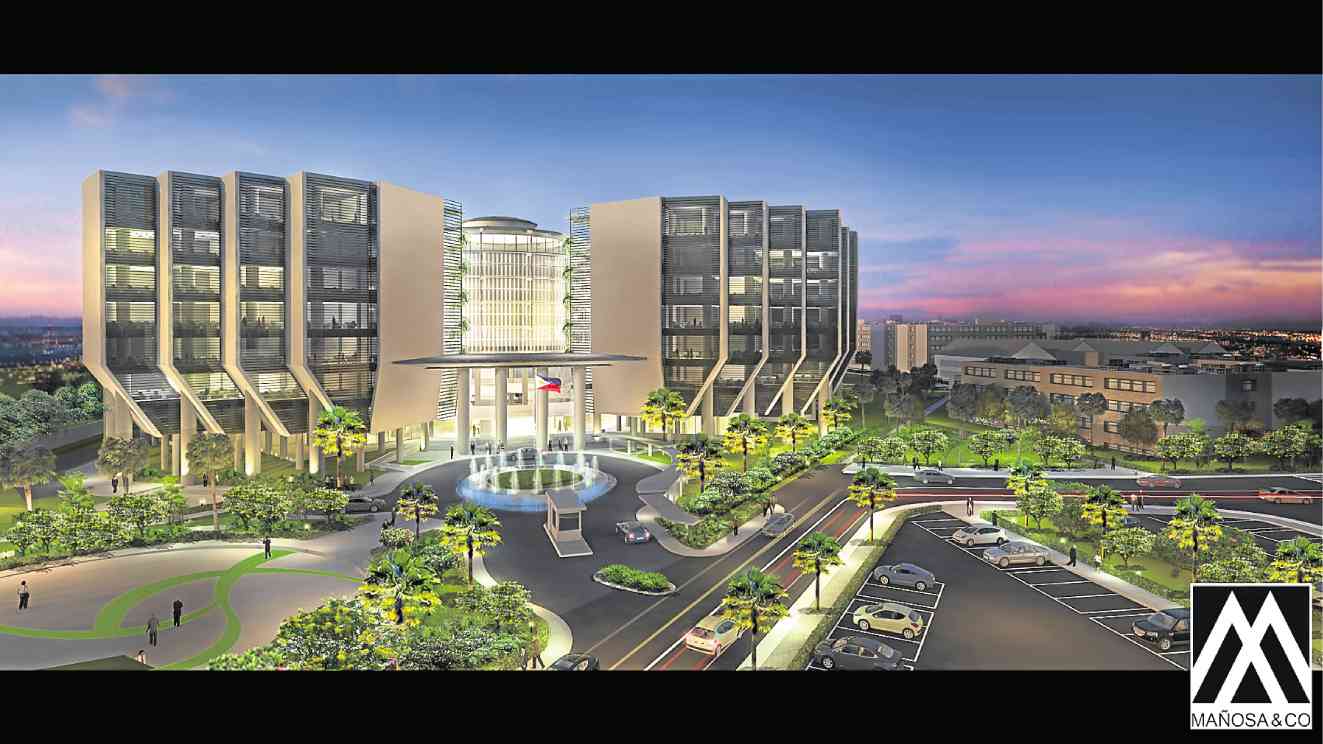
However, the plan fizzled out for some reason and the next we heard was almost a decade later in 2024 when it was announced that the Supreme Court would move to a larger area than Taguig, a “Judicial Complex” which is to be built in the planned government center near the New Manila International Airport in Bulakan, Bulacan. And it’s not just the Supreme Court that would move there but also the second-level courts of the country which are the Court of Appeals, Court of Tax Appeals, and the Sandiganbayan. Yet once again, nothing has been heard about the developments of this “judicial complex” yet, not even what the buildings in the complex would look like. So we may have to wait for another decade for it to either see fruition or be cancelled yet again.

But while the future of a new home remains in limbo, what remains clear is the Supreme Court remains a vital institution in ensuring a functioning judicial system in the country, one that strives to ensure that justice is served to the people that need it in these challenging times, despite its shortcomings at times.

My thanks to the Supreme Court Office of the Spokesperson for organizing a one of a kind tour that helps bring about a better understanding of the Supreme Court and its role in nation-building
Acknowledgements as well to the Supreme Court of the Philippines, Wikipedia, Skyscrapercity, and Taguig.com
See these places on The Urban Roamer's Map