After the initial projections made about the initial strength of Typhoon Ruby/Hagupit, (as it is known internationally) Metro Manila and surrounding areas were fortunate that the typhoon weakened considerably by the time it hit there. Thus, these areas were spared of the damage the typhoon initially brought.
path taken by Typhoon Ruby/Hagupit (courtesy of BBC)
Meteorologists explained that typhoons weaken considerably when it makes a landfall. In the case of this typhoon, it made a landfall at least twice in Samar and Masbate which helped weaken its strength from typhoon to tropical depression levels.
I remember that before, strong typhoons are not usually expected to hit the country during November-December. Unfortunately, and sadly, this is no longer the case these days as the climate change phenomenon of recent decades has messed up our planet’s climate, causing strong typhoons to hit our shores even during a period when it was traditionally considered a non-typhoon season.
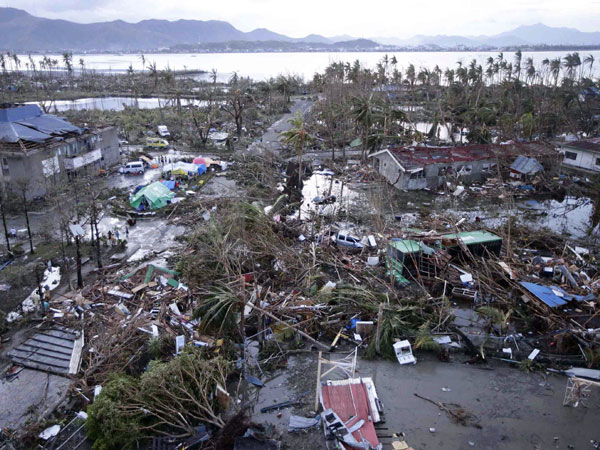
Tacloban, Leyte after Typhoon Yolanda, 2013 (courtesy of Inquirer)
One should not look further than check out the country’s typhoon history for the past 3 years. 2011’s Sendong and 2012’s Pablo hit Mindanao in December and there was Yolanda in November last year which struck the Visayas in particular.
It was a Wednesday morning of heavy downpour and strong winds that managed to put the metropolis into a complete standstill, Roofs were blown and trees were uprooted as such heavy debris closed some streets. Thousands were evacuated from their homes while some were stubborn in staying behind. Power went down hours before dawn and mobile lines became spotty.
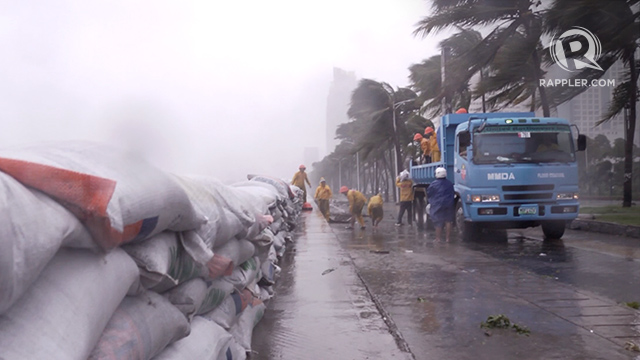
piling up sandbags in the event of a possible storm surge in Manila Bay (courtesy of Rappler)evacuated families in Sucat, Muntinglupa (courtesy of GMA News and @adsibal)power outage due to Typhoon Glenda affected even establishments like the Manila Hotel (courtesy of Carlos Celdran on Facebook)
Despite such display of fury Typhoon Glenda, (international name: Rammasun) has shown, the metropolis managed to make it through, thanks in part to a prepared disaster management teams of the Metro Manila Development Authority (MMDA) and the local governments and the fact that Glenda slight veered in a different direction as it managed to not directly hit the metropolis even though Signal No. 3 has been raised in Metro Manila and surrounding provinces.
Heads up, metro denizens. Typhoon Glenda (international name: Rammasun) has officially entered the Philippine area of responsibility Sunday night.
as of 5 AM, Monday, July 4 (courtesy of PAGASA)
Based on the storm’s possible projection, it is expected that the storm may hit Central Luzon by midweek, affecting not only that area but also nearby areas, especially Metro Manila with heavy rainfall. As of this writing, Storm Signal No. 1 has been raised over parts of the Bicol region.