By the time this piece is being published, it would be the Feast of Christ the King, which celebrates the kingship of Jesus Christ of the heavens and the earth. This particular feast is actually celebrated in many Christian churches but the Roman Catholic Church in particular celebrates it around this time in November to signify the end of the liturgical calendar as it prepares for the new liturgical calendar during the Advent.

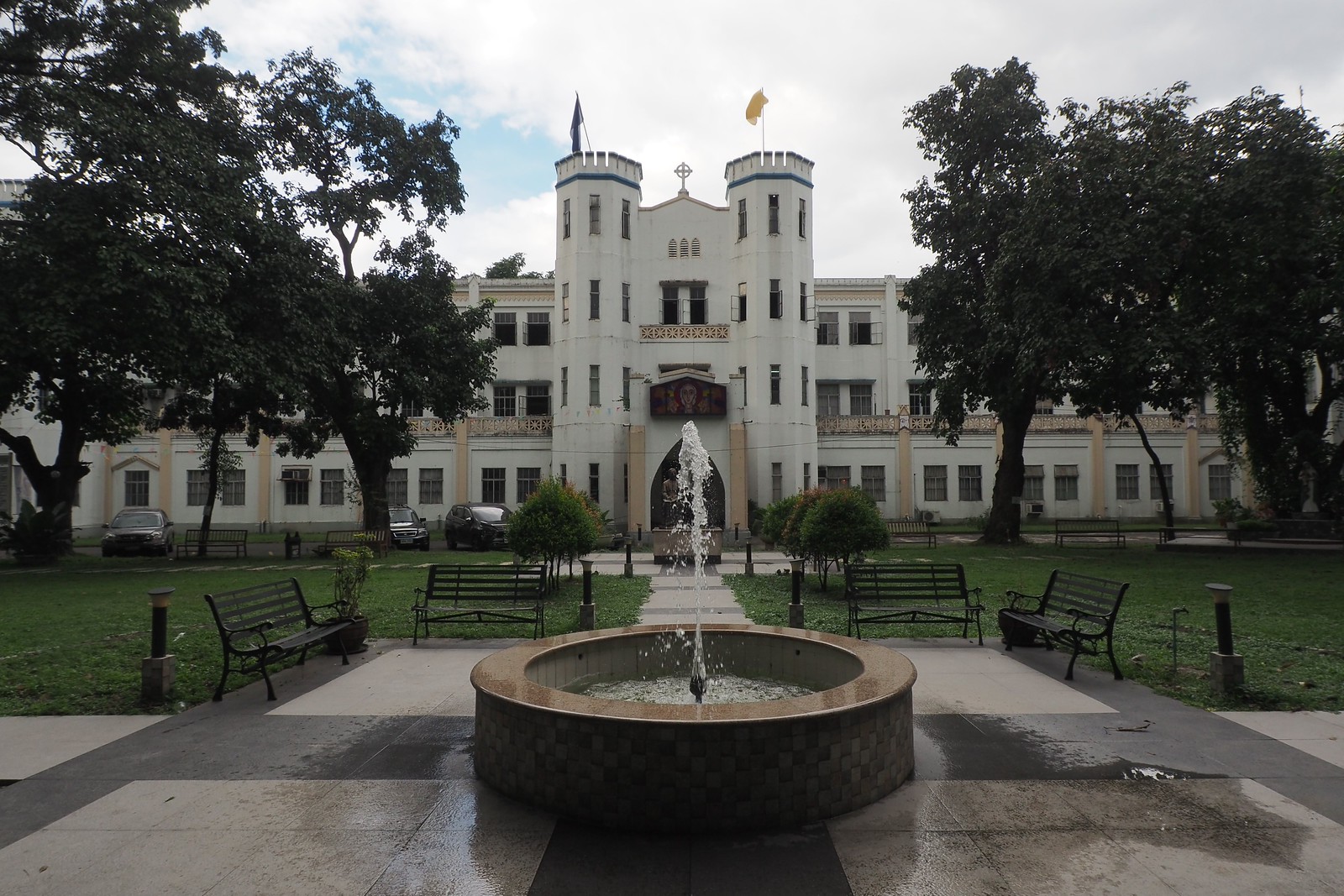
Thus it is fitting that in time of the Feast of Christ the King, the Urban Roamer recently had the opportunity to explore a sacred place in the metropolis dedicated to Christ the King, the Christ the King Mission Seminary (also known as the Divine Word Mission Seminary) in the aptly named Barangay Kristong Hari (Christ the King in Tagalog) in Quezon City’s New Manila district.
A Home for a Young Congregation
To learn the story of the Christ the King Mission Seminary, it is important to learn the story of the Catholic religious congregation who built it, the Society of the Divine Word or SVD (the initials stand for its Latin name “Societas Verbi Divini”) It is actually a fairly young religious congregation compared to the Dominicans, Franciscans, and even the Jesuits, having been founded in Germany in 1875 by a German priest Arnold Janssen. The SVD went to work straight away with missionary work in China by 1879 spearheaded by one of its first priests Joseph Freinademetz. Janssen and Freinademetz are today considered as the pillars of SVD, having both been canonized as saints in 2003.

SVD missionaries would make their way to the Philippines in 1909 but they did not establish themselves in or around Manila right away. Instead, they established their first mission in Bangued, Abra and spent the next two decades establishing missions in Northern Luzon. And as the work of the SVD missionaries in the country, there was a pressing need to establish a mission seminary in the country.

In 1929, the SVD General Council based in the Netherlands signed off on the plan for the construction of an SVD mission seminary in the Philippines. The task of overseeing this plan come into fruition was Fr. Theodore Buttenbruch, the Regional Superior of SVD in the Philippines. Also providing support was a fellow SVD, Bishop William Finnemann, SVD, who was then the auxiliary Bishop of Manila, and would eventually be the first bishop of the Diocese of Mindoro. The place Buttenbruch would choose would be a vast open space along España Extension (now E. Rodriguez Sr. Avenue) in New Manila, an area that was about to be transformed into an upscale neighborhood.

The Seminary Rises and Grows
Buttenbruch originally tapped the services of German architect Arthur Julius Niclaus Gabler-Gumbert, who designed the Coca-Cola offices in Paco, Manila. However, the Gabler-Gumbert plans were reportedly expensive so Buttenbruch eventually hired French engineer Marion M. Karolchuck who designed the San Fernando de Dilao Parish in Paco, Manila. As such, it is unclear as to whether Gumbert or Karolchuck was responsible for the design of the original buildings in the site. For all we know, it could be a work of both with Gumbert having done the original designs and Karolchuck added his own touches during construction.

Whatever the case, work would begin for the SVD mission seminary site in 1933 and would be completed the following year. Suffice to say, the result was unlike anything seen before in Manila or in the country for that matter. The new building was built in the design of a fortress castle, an unusual choice for something as spiritual as a seminary. But the choice was deliberate as it was to be dedicated to Christ the King and structure served to symbolize the power and authority of Jesus Christ as king. The building would eventually be known as the Buttenbruch Building, named in honor of its builder who sadly lost his life during the Japanese Occupation of the country in World War II.

Another building would be built in the area in the late1930s, echoing the architecture of the Buttenbruch Building though somewhat less imposing. It would eventually be known as the Finnemann Building, named after the aforementioned Bishop Finnemann, who would also be killed by the Japanese forces in World War II.


While the two buildings are familiar sights to anyone visiting the seminary grounds, perhaps the most “public” of these spaces would be the seminary chapel, which is now elevated to become the Diocesan Shrine of Jesus, The Divine Word. The church was designed by Fr. Friedrich Linzenbach in the late 1960s, with Bro. Josef Hueger as Construction Engineer. The layout is shaped like a fan or a shell, a unique layout but not as uncommon as it was being used for a number of churches built duirng that period of the 1950s-1960s, including the National Shrine of St. Jude Thaddeus in San Miguel, Manila, which also happens to be an SVD-administered church as well.


Another unique feature of the Shrine of Jesus, the Divine Word is the lack of a crucifix in the altar, the typical centerpiece of a Catholic church. What we see instead is a massive stained glass artwork portraying Jesus Christ as the Eternal King.

A “Hidden” Garden Oasis
As with many seminary complexes, Christ the King Mission Seminary has maintained much open, green space despite the buildings and other facilities built in the area over the years. However, there is one particular spot in the complex that caught this Roamer’s surprise for the greenery and serenity it holds.

That spot is the Garden of the Divine Word, which is actually a columbarium. That should come as no surprise though as resting places of the dead, despite their creepiness, actually serve as nice open spaces one can visit to find some peace (hopefully not the “rest in peace” kind…yet) in the midst of the urban madness.
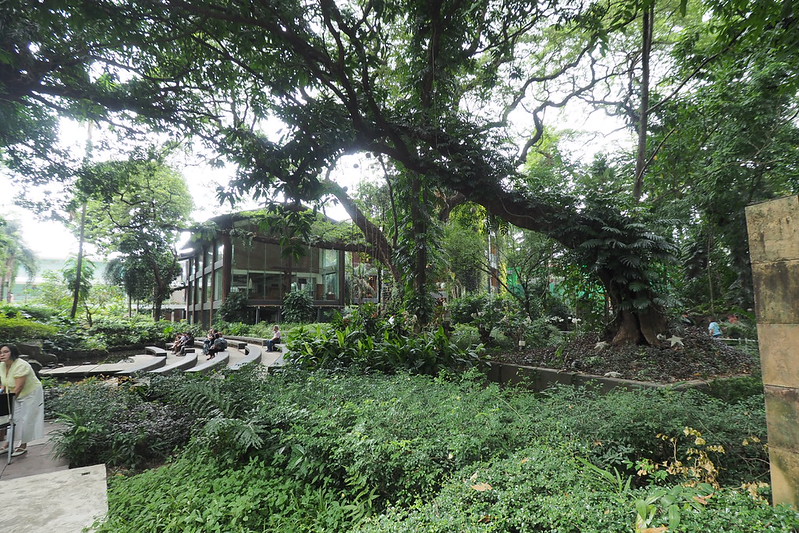

What makes the Garden of the Divine Word stand out personally was that it was designed not only for the dead but for the living as well, with towering trees, lush plant life, and ponds that put you in the midst of nature despite the place being in the middle of the metropolis. There is also an amphitheater which serves as an open air chapel, the centerpiece of the area, with the added touch of a structure designed like a cave to give the area a more “natural” atmosphere to it.


Of all the resting places featured on this site, the Garden of the Divine Word is probably one of this Roamer’s favorites now for being designed as a true urban oasis.
A Place of Contrasts…Or Is It?
Looking at the whole Christ the King Mission Seminary complex at face value, there seems to be a contrast in this area’s character. On one hand, you have imposing structures that symbolize the power and authority of Jesus Christ as the Eternal King. By contrast, there is the columbarium garden that evokes a sense of serenity and gentleness, not authoritative in any way.

Then again, that is the character of Christ. He is both stern in expecting those who believe in Him to follow His commandments but is also gentle to say, “Come to Me and I will give you rest.” There is no contradiction in the first place but rather a full picture of what Jesus Christ as King.

Whether you are a Christian or not, the Christ the King Mission Seminary is a unique place that lets you visually understand the concept of Jesus Christ as King. At the very least, it is a serene place worth visiting that provides a sense of calm needed to get through in these challenging times in such a chaotic world.
Big thanks to Jing Ordoña of Manilakad Tours for organizing a tour of New Manila last October 31, 2026, which made possible for the Urban Roamer to visit the Christ the King Mission Seminary up close. If you want to join a possible future New Manila tour or any of his other tours, contact Jing on Facebook.
Acknowledgements as well to the Divine Word Mission Seminary, Lakbay ng Lakan, and Scribd
See this place on The Urban Roamer's Map